


Flu Vaccinations 2024
Important Flu Vaccination Update
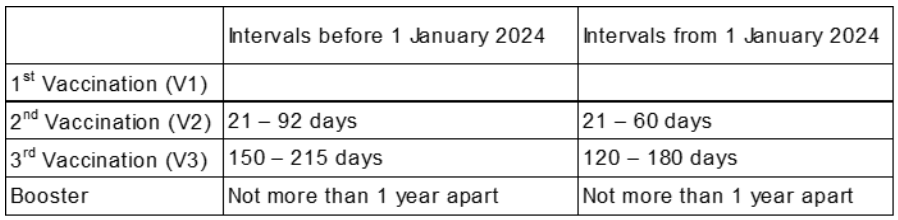
Following advice from British Equestrian, BRC will be amending the intervals of new or restarting flu vaccination courses from 1 January 2024. Vaccinations that are up to date and correct are not altered by this change, only courses starting after 1 January 2024 are affected.
Important reminder that 2024 is a leap year and whilst they are not counted for annual vaccinations, the extra day must be considered for the primary course (V1 – V3).
Other vaccination rules will remain the same. Full details will be found in the 2024 Handbook when available.
Vaccination courses started before 1 January 2024 may follow either of the intervals set out below.
G7: EQUINE INFLUENZA
G7.1: Vaccinations against Equine Influenza
This rule applies in respect of any horse or pony which competes in a BRC area qualifier and/
or championship.
The horse or pony must have been vaccinated against equine influenza by a veterinary
surgeon who is not the owner of the animal, in accordance with the following rules:
The horse or pony must have received a primary injection followed by:
• a second primary injection which is given not less than 21 days and not more than 92
days after the first
• a first booster injection which is given not less than 150 days and not more than 215 days
after the second primary injection
• further annual booster injections at intervals of not more than a year apart.
If the current vaccination programme started AFTER 1 January 2018:
• the first two primary injections must be correct i.e. the second given between 21 and 92
days after the first
• the first booster must be given between 150 and 215 days after the second primary injection
• all annual boosters must be correct.
However, any errors with first booster (which should be given 150 – 215 days after the
second primary injection) or annual booster given BEFORE 1 January 2018 may be ignored
provided that:
Section 2
B R C M E M B E R S H A N D B O O K 23 This item contains Personal Data
• the first two primary injections are correct i.e. the second given between 21 and 92 days
after the first
• all annual boosters given AFTER 1 January 2018 are correct.
In order to compete a horse must be vaccinated in accordance with the above rules (and
not in any of the 6 preceding days) of the competition and/or entry to competition stables.
No injection should have been given on any of the 6 days before the competition
and/or entry to competition stables. For example: if the horse is vaccinated on the
Monday, the horse will not be eligible to enter championship stables, or compete until the
following Monday.
Horses may compete providing that they have had the first two primary injections providing
the second vaccination is within 6 calendar months and 21 days but not in any of the 6
preceding days of entry to the competition or competition stabling.
In the event of failure to comply with any of the requirements of this rule, the horse or pony will
be disqualified and not permitted to take part in any competition to which these rules apply.
Any alterations to any entries on the vaccination record must have been made, signed and
stamped by a veterinary surgeon.
Due to an unprecedented vaccination shortage, horses whose annual booster
vaccinations fell between 1 September 2022 and 1 January 2023 the annual booster
may be given up to 15 months, provided that the following vaccination is given within
the following 9 months resulting in the horse having 2 boosters in the 24 month period.
This must be recorded in the passport and signed/stamped by a Veterinary Surgeon, or
accompanied by a signed letter to that effect.
E.g., if your annual vaccination is due on 14 November and your vet practice are unable
to vaccinate due to a shortage, you can extend the annual vaccination by up to 3 months.
Annual vaccination can therefore be administered on or before 14 February, then following
the guidance above must be vaccinated with an annual within 9 months. Ensure you have
confirmation from the vets this is the case when attending a competition.
Annual boosters due on or after 1 January 2023 must revert to the usual 12-month interval
found in G7.1.
BRC will continue to strongly recommend a 6 month vaccination when attending BRC
qualifiers and championships and maintaining good biosecurity. BRC reserve the right
to amend these vaccination rules.
G7.2 Checking of Passports and Equine Influenza Records
For the purposes of determining whether the requirements of these rules have been met, the
following documents must be available for inspection in respect of a horse or pony which is
taking part in a BRC Area Qualifier or Championship.
• any passport issued for the horse and
• the full vaccination records for the horse if this is not contained in the passport
The identification of the horse or pony may be checked against that contained in the passport
or on the flu vaccination record. This may be done from the diagram and description of
the animal or by microchip providing that the microchip number has been recorded in the
passport or flu vaccination record.
Please see rule G7.6 regarding rules on microchips. Spot checks will be carried out.
Section 2
24 B R C M E M B E R S H A N D B O O K This item contains Personal Data
The vaccination section of the horse’s passport must have been completed, signed/
stamped, by a Veterinary Surgeon who is not the owner of the horse or pony.
The dates on which the vaccinations were given must comply with the requirements as stated
in G7.1.
G7.3 Incorrect Vaccinations
A yellow/red card system will be adopted for qualifiers and championships, whereby a
yellow card can be given to a competitor, allowing them to compete, with an advisory
notice to get the vaccinations corrected within a set time frame. A red card will be given
where welfare of the horse is compromised or for a second offence, an advisory notice
will be issued to ensure correction of the incorrect flu vaccination.
At qualifiers this system will be implemented by the Official Steward and at
championships through the Ground Jury.
No refund of entries or stabling fees will be awarded for any disqualification at either
qualifiers or championships.
Every effort is made to ensure that flu vaccination checking is carried out correctly.
BRC accepts no responsibility whatsoever for any losses incurred, whether directly
or indirectly due to incorrect checking. It is the sole responsibility of the competitor to
ensure that their horse’s flu vaccinations are valid and it should not be assumed that
because vaccinations have been accepted at one competition in good faith, it will be
accepted at another competition.
G7.3.1: Yellow Cards
Yellow cards will be issued provided that the welfare of the horse is not compromised. An
advisory notice will be issued and reported to the BRC Office. A competitor will be given
a period of 28 days, or, before they next compete in a BRC qualifier or championship,
taken from the date the advisory notice is issued to rectify. The period of 28 days is given
when competitions are running close together, allowing the horse to compete within
the 28 days without being penalised. Once the 28 days has expired, the Flu Vaccination
certificate must be corrected before competing is permitted. Yellow cards must be
rectified before attending a championship where possible. If not feasible due to timescale
of events, dispensation must be granted from BRC Office for the competitor to attend,
it is the responsibility of the competitor to gain dispensation from BRC before the event
they wish to attend. Competitors issued with a yellow card will be permitted to compete
in the qualifier or championship the flu vac failure has been identified at.
Examples of where a yellow card would be given with an advisory notice to rectify the
issue/restart the vaccinations within a set period of time but not limited to are:
• First booster date has been given too early/too late
• Primary injections given too early/late
• Errors with annual vaccination
• No veterinary stamp
• Incorrect date written in passport
The advisory notice will inform the action to be taken where possible.
G7.3.2 Red Cards
Red cards will be issued when there is a potential risk to horse welfare. An advisory
notice will be issued and reported to the BRC office. Competitors who receive a red
card will not be permitted to compete in the qualifier or championship where the flu
vac failure has been identified at. The horse may not be able to compete at subsequent
qualifiers or championships depending upon the error, until this is corrected.
Section 2
B R C M E M B E R S H A N D B O O K 25This item contains Personal Data
Examples of where a red card will be issued, resulting in disqualification from the
event, but not limited to, are:
• No vaccinations presented at all or more than 6 months overdue
• Vaccination given on any of the 6 days preceding the competition or entry to stabling
• No microchip
• Failure through having received a yellow card, to not make the corrections
G7.3.3 Flu Vaccination Reporting
All errors with flu vaccinations will be reported to the BRC office and kept on record.
For yellow cards the details will be kept until the error is corrected. For red cards the
details will be kept for a period of 12 months from the date BRC is notified, the error
has been corrected.
It is the competitor’s responsibility to ensure any advisory notices are acted upon,
failure to do so may result in disciplinary action being taken and/or disqualification.
Official Stewards will receive regular updates of horses on record along with the horse
details i.e. passport number/microchip number, the competitor’s name and club for
their records.
G7.4: Flu Vaccination Checklist
A copy of the flu vaccination checklist is in CR Appendix 13 and should be used as follows:
• take the date of the first injection and look this up in the column headed
INJECTION DATE
• compare the dates in 21 DAYS and 92 DAYS columns with the date in the flu vac record
for second injection, if the date is within range it is fine, if not it is an invalid record
• take the date of the second injection and look this up in the column headed INJECTION
DATE again
• compare the dates in 150 DAYS and 215 DAYS columns with the date in the flu vac record
for third injection (first booster), if the date is within range it is fine, if not it is an invalid
record (unless the two primary injections were before 1 January 2016)
• leap years are not recorded in the checklist, so you may need to adjust the date to take
the extra day into account.
G7.5: Names on Passports
The name shown on the passport/flu vaccination record must be the one that is used on all
official competition entry forms. If a stable name is also shown on the passport/flu vaccination
record this must be signed and/or stamped by a veterinary surgeon. If a horse is unnamed in
the passport, any name may be used, but a microchip must be present for the purposes of
identification.